
HAYLEY FOSTER

SHORT TALK. BIG IMPACT.
FSA Supplemental Materials
This page brings together the essential context, definitions, and official guidelines behind TED-style and high-impact talks. You’ll learn what TEDx events truly are - and just as importantly, what they are not. Use these insights to avoid common pitfalls and align your message with what organizers are actually looking for.
Topics:
We Love our NSA Colleagues: A Special Gift until February 14th!
Contact Hayley for a complimentary, targeted 20-minute chat!
What is a TEDx event?
(Sourced from TED.com - before you start)
Imagine a day filled with brilliant speakers, thought-provoking conversations and new connections. By organizing a TEDx event, you can create a unique gathering in your community that will unleash new ideas with the potential to inspire and inform.
A TEDx event is a local gathering where live TED-like talks and performances are shared with the community. TEDx events are fully planned and coordinated independently, on a community-by-community basis. The content and design of each TEDx event is unique and developed by each organizing team but all events share these common features:

TED's format
A suite of short, carefully prepared talks, demonstrations and performances that are idea-focused and cover a wide range of subjects to foster learning, inspiration and wonder – and provoke conversations that matter.
Diversity of topics
All TEDx events present multiple issues and a diversity of voices from many disciplines. After all, what’s the fun without a little variety?
Community-driven and bias-free content
A TEDx event is organized by volunteers from the local community, and just like TED events, it lacks any commercial, religious or political agenda. Its goal is to spark conversation, connection and community.
What a TEDx event is not:
- A TEDx event isn’t an industry or marketing conference. It isn’t limited to one topic or field. It isn’t used to sell something.
- A TEDx event is not organized by or for special-interest political, religious or commercial groups.
- A TEDx event cannot be used to raise money, not even for a charity.
- A TEDx event cannot partner with another conference or event.
- A TEDx event can’t be co-branded with an institution except under specific license types – available to a college or university, or for internal events (for the employees of an organization).
- A TEDx event is not a platform for professional or circuit speakers, such as motivational speakers and professional life coaches. Its purpose is to give a platform to those who often do not have one.
- A TEDx event is not focused solely on entrepreneurship, business or technology. Diversity of topics is key!
TED-Style, Signature Talks, Short Talks & High-Impact Presentations
These talks define your voice, your authority, and your message.
- 1) TEDx talks
- 2) Short form keynotes
- 3) Founder or CEO signature talks
- 4) Thought-leadership and “future of the industry” talks
- 5) Author’s talks
- 6) Personal brand
- 7) Personal transformation story
- 8) Origin-story talks
- 9) Lightning talks
- 10) Ignite-style and PechaKucha-style talks
- 11) Award acceptance speeches
- 12) High-visibility introductions
- 13) Pitch coaching for Venture capital and angel investor funding
- 14) Demo Day pitches for Entrepreneurial Startups
- 15) Proposal summaries
- 16) Leadership Updates
- 17) Executive briefings
- 18) Board of Director presentations
- 19) National Speakers Association chapter talks
- 20) Toastmasters International Accredited Speaker speech
- 21) Member spotlight or showcase talks
- 22) Short-form video talks for all forms of social media
- 23) Brand videos for website, LinkedIn etc
- 24) Promotional or launch videos
- 25) Fundraising Talks
- 26) Donor talks
- 27) Nonprofit or mission-driven pitches
Hayley helps you:
- Clarify what kind of talk you’re really giving
- Structure it for your audience and context
- Shape it so your message is credible, memorable, and makes the desired impact
Types of Talks Hayley Coaches
Hayley works with speakers, leaders, founders, and experts who need their ideas to land clearly, confidently, and with impact—often in high-stakes or short-form moments where every word matters. Whether you are preparing for a major stage, an investor room, a board meeting, or a camera lens, Hayley helps you shape a talk that is structured, compelling, and strategically aligned with your goals.

If it matters, if it’s visible, and if you need it to land - Hayley can help.
Beyond TEDx Business Builders
10 ways that creating a TEDx talk will make you a better speaker
- 1) Understanding the difference between a short talk and a TED-style talk
- 2) Becoming aware of the many places where you must talk short
- 3) Generates trademarkable content creation
- 4) Gain a new way of thinking about speaking
- 5) Learning how to be succinct
- 6) Learning how to engage interest
- 7) Receiving a template for talk construction
- 8) Using a method that makes your content modular for multiple uses
- 9) Discover how to make key components memorable and repeatable
- 10) Implementing a time-tested strategy to give a winning talk every time
Leveraging your TEDx talk can advance your brand.
These time-tested tactics ensure you will receive dividends deep into your business.
- 1) Thought Leadership/ Seen as the leading expert
- 2) Include in your BIO, which circulates to:
a. Speakers b. Speakers' Bureaus c. Social Media Profiles d. Event Marketing for your session
- 3) Instant positioning for conferences, panels, podcasts, workshops
- 4) Becomes a credential to include in client proposals
- 5) Creates brand consistency across platforms
- 6) Turn the talk into written content to further impression of you as the expert
- 7) Create blog posts, write articles, ebooks, whitepapers based on talk content
- 8) Use of your core message or walkawaytalk as your business tagline
TED's Curation Guidelines
(Sourced from TED.com)
Values
TED is a non-profit organization seeking to discover, debate, disseminate and activate ideas that matter. Here are the core values driving our mission.
Curiosity
It all starts here. Open minds infused by curiosity give birth to catalytic questions. Exploration of those questions can open up a world of wonder and create a desire to learn. Thus begins a journey of discovery, bringing together dreamers, thinkers and doers. Curiosity is the spark that ignites every powerful idea.
Reason
Ideas must be grounded in truth. But how? The truth is notoriously elusive. Our best tool for pursuing it is reason, that enlightened method of persuasion which shuns personal bias in favor of facts, logic and evidence. This is our path to reliable knowledge and deepened understanding. Reason is also the foundation on which science is built. TED is committed to good science and its mindset of exploration and evidence-based explanation. We ask speakers to provide sources, citations and footnotes, and we review all talks for accuracy. If claims made in a TED Talk are subsequently discredited, we seek to provide clear updates.
Imagination
Humans are capable of repatterning the world. We celebrate this astonishing ability with many names: imagination, invention, innovation, vision, design, creativity. In each case, ideas are generated that can literally reshape our future. They may do this by providing solutions to challenging problems. Or by conjuring previously undreamed of possibility that people are then inspired to make real.
Inclusion
Ideas are for everyone. They can't be fenced off by borders, whether of geography, religion, politics or culture. And no single origin, race, gender, identity or class can claim preferential ownership over them. TED is committed to a global mindset. We seek to source ideas from everywhere and to make them widely and freely accessible. Powerful ideas, expressed and distributed with care, can bring different groups together and create a shared vision of a future worth pursuing.
Generosity
Generosity underpins our operating strategy - not just because it is good, but because it is infectious. The two most important decisions in our organization's history were posting our talks online, and allowing local event organizers to use our brand, leading to astonishingly generous responses from countless individuals around the world. Generosity is empowerment. Our best work is not what we do, but what we empower others to do, as evidenced every day by the extraordinary work of our speakers, translators, TEDx organizers, business partners, educators, animators, fellows and donors.
Debate
Our content isn't the final word on anything. Skeptics are welcome, and may play a key role in improving an idea or revealing its flaws. Others may find that conversation after a talk is the best path to clarity or figuring out what to do with it. We strive to provide a neutral, open space for vigorous discussion and debate both online and face to face. The tone should, of course, stay respectful. Bigotry and hate speech have no place on our platform. But constructive conversations can be a powerful antidote to division.
Impact
All of the above is in pursuit of a better world for humanity, present and future, and for our fellow creatures on planet Earth. We firmly believe in the power of ideas to help create that world. But it doesn't happen automatically. Ideas need to be crafted with care, communicated in a way that persuades and inspires, spread to millions of minds - and then, crucially, turned into action by catalytic individuals and communities. We seek to enable every step on that journey.
TED Content Guidelines
(Sourced from TED.com policies + terms)
As stewards of ideas worth spreading, TEDx organizers share the responsibility of maintaining TED’s reputation as a forum for sharing ideas that matter and upholding our audience’s trust. These guidelines help us to responsibly share ideas with a global audience while upholding TED’s mission and values.
Guideline 1: No commercial agendas
If it's essential to a talk that the speaker mentions what they do and describe the businesses that they're in, they should. But, speakers may never use the TED or TEDx stage to pitch their products or services, plug their books, or ask for funding. While entrepreneurs and business leaders can speak at TEDx events, their talk should be driven by an idea and not sell from the stage.
A TEDx event is not a platform for professional or circuit speakers, such as motivational speakers and professional life coaches — it's a fine line between shameless self-promotion and wholesome self-reporting. As a rule of thumb: if it feels like an advertisement, it probably is.
Guideline 2: No political agendas or inflammatory rhetoric
Politics, social issues, and policy are key parts of the global conversation. However, TEDx stages are not the place for partisan politics, nor for extremist or inflammatory positions. Speakers must not attack or advocate for parties, party platforms, and political leaders in their talk. They must not advocate for violence or oppression. Advise speakers to focus on discussing concrete problems and solutions.
Special care should also be taken with politically divisive subjects (eg. abortion, gun control) so as to avoid polarizing “us vs. them” language. Instead, speakers should focus on consensus-building and nuanced discussion. Consideration should also be given to any content that may carry negative connotations for other parts of our global audience.
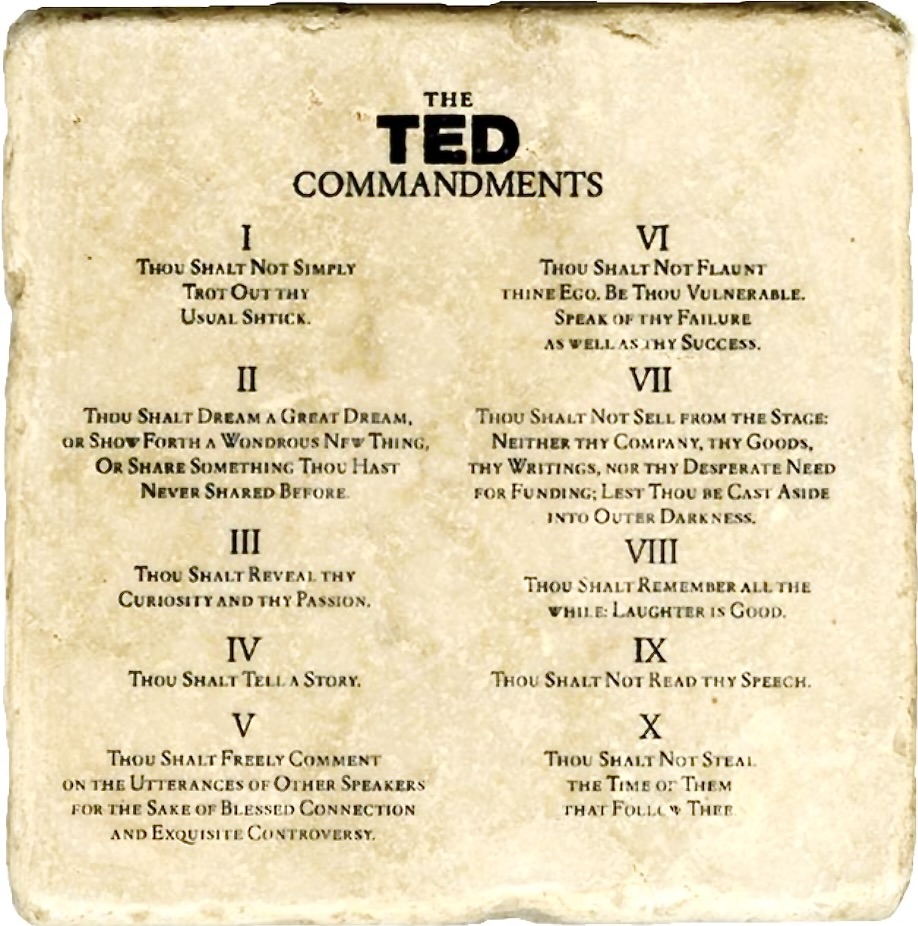
Courtesy of original TEDxOrganizer Hayley Foster
The TED Commandments from the beginning of TEDx time
(circa 2009)
Yes, TED really used to send them to speakers! In her 2008 TED Talk, "Where does creativity hide?" The novelist Amy Tan described the arrival of the "TED Commandments" for an upcoming talk as something that "creates a near-death experience," though she added that "near-death is good for creativity".
Guideline 3: No religious agendas
Don't book speakers who attempt to prove or persuade the correctness of a single religion, deity or other belief system (such as atheism or agnosticism), whether through rhetoric or "scientific proof." Be wary of speakers promoting new age beliefs, including concepts such as quantum consciousness, Gaia theory, archaeoastronomy, and drug-induced spiritual epiphanies. Speakers can be honest about their beliefs, but should not use the stage to promote them or to denigrate those who don’t share them.
Guideline 4: No bad science
TED offers scientists and other experts a platform to provide scientific information directly to millions of people around the world. Learn more about TED’s Science Standards.
Science is a big part of the TED universe, and it’s important that TEDx organizers sustain our reputation as a credible forum for sharing ideas that matter. It’s not always easy to distinguish between science and pseudoscience. And the more willing a speaker is to abandon scientific underpinning, the easier it is for them to make attention-grabbing claims. This is especially true for talks that call on science for support but do not come directly from the scientists themselves.
Claims made using scientific language should:
- Be testable experimentally
- Have been published in a peer-reviewed, respected journal
- Be based on theories that are also considered credible by experts in the field
- Be backed up by experiments that have generated enough data to convince other experts of its legitimacy
- Have proponents who are secure enough to acknowledge areas of doubt and need for further investigation
- Not fly in the face of the broad existing body of scientific knowledge
- Be presented by a speaker who has the right scientific qualifications
- Show clear respect for the scientific method and scientific thinking generally.
Claims made using scientific language should not:
- Be so obscure or mysterious as to be untestable.
- Be considered ridiculous by credible scientists in the field.
- Be based on experiments that can not be reproduced by others.
- Be based on data that do not convincingly corroborate the experimenter’s theoretical claims.
- Come from overconfident advocates.
- Use over-simplified interpretations of legitimate studies.
- Include imprecise vocabulary. (Phrases like “quantum consciousness", ”personal energy fields,”
- “crystal healing”, and the like, should be considered major red flags.)
- Abandon evidence-based thinking or be dismissive of the scientific method.